Evidence Suggests CTU Is Using Mischievous Marketing Methods As It Seeks Control Over the Chicago Board of Education
It starts simply enough with a text message from Amy at McGuire Research. Of course, I’ve never heard of McGuire Research and thus it’s impossible that I know Amy. But she uses my name – sure it’s in all caps – and says “Hi” like we are old friends. Amy tells me that my opinion matters on important issues facing Chicago & my responses would be kept confidential and only be used for research purposes. Who among us would not be intrigued?
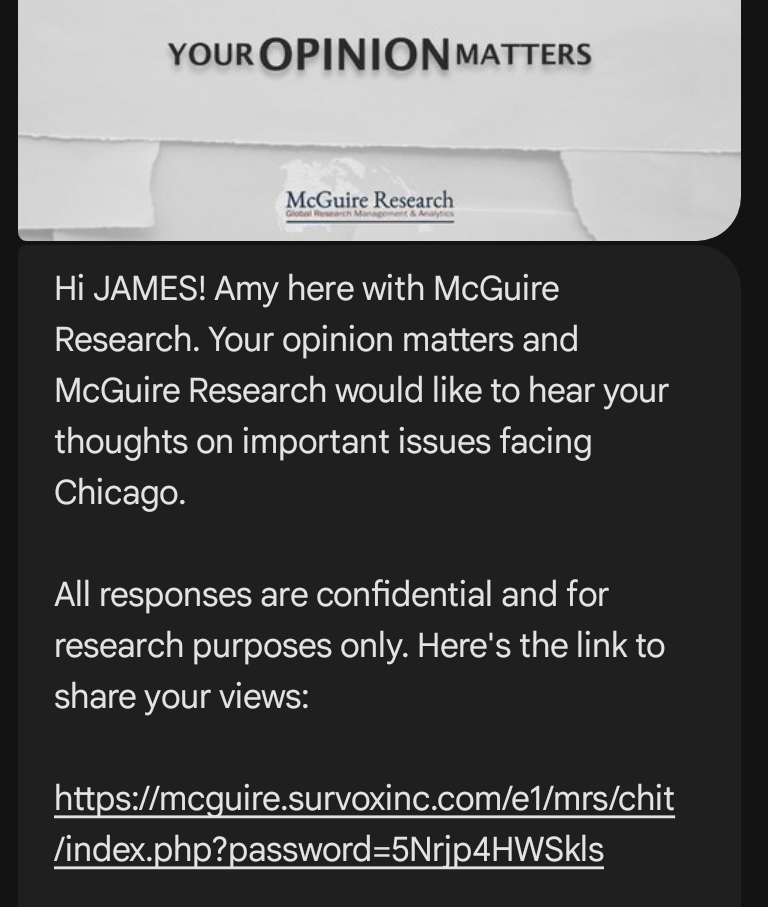
Not being one to click on links sent by unknown companies, a little research was required. After confirming that McGuire and Survox were indeed legitimate, the link was copy-and-pasted into a private Brave browser window.
First Red Flag: Proceed With Caution
It’s worth noting that McGuire appears to be a completely legitimate, albeit left-leaning, research company. It claims to offer data collection & tabulation, advanced analytics and other services to clients in dozens of countries including Fortune 500 companies, municipalities, and political campaigns. Nevertheless, many of their disclosed clients are democrat-leaning. Apparently McGuire has done work for the California Teachers Association, construction-trades unions in California, and several democrat candidates and committees. Locally it’s been alleged, but not necessarily established, that McGuire is the preferred research company of the Chicago Teachers Union.
However legitimate McGuire may be, discerning readers will notice that Amy claims responses will be “confidential” but she does not say “anonymous”. It’s clear that McGuire already knows my name and cellular number. Then there is that interesting “password” as part of the URL. A 12 digit code using 62 possible characters (A-Z, a-z, 0-9) yields 3.2×10²¹ combinations; enough for every person on the planet many times over. Any reasonably thinking person would conclude that one’s survey answers will end up tied to one’s identity. This is, potentially, a huge problem.
The American Association for Public Opinion Research’s Code of Professional Ethics and Practices is unambiguous; the rule is to not identify people with their answers. The protection of respondents’ identities is considered a core ethical duty. So much so that researchers are even ethically barred from revealing respondents’ answers in courtrooms. And if one thinks about it for a moment, the rule makes perfect sense.
Consider what would happen if an organization like the CTU wanted to conduct some research regarding how it is perceived by the public & a super-majority of responses describe Stacey Davis Gates as stupid and ugly. If the individuals’ responses are not separated from the individuals’ identities then the Ludicrous SDG would be able to identify all of the individuals who responded that she was stupid and ugly. It then stands to reason that SDG might take some action with such information. The next thing you know a herd of angry insane red t-shirt wearing women sporting low maintenance haircuts is out protesting in front of the workplaces of respondents who believed SDG to be stupid and ugly.
Once that happens, respondents have only two options: either no longer participate in research, or cease to give honest responses. Both options are problematic to researchers. The first reduces the fraction of the population willing to provide their opinion which drives up research costs. The second introduces bad data into the dataset which at best increases the statistical margin-of-error, and at worst makes the entire dataset incorrect, useless.
Matching responses to individuals is unethical because it taints research results.
This is why the AAPOR’s rules demand that all personally identifiable information be stripped from results – or not gathered in the first place – as soon as possible.
For these reasons, the public would be well served holding a healthy dose of skepticism regarding any “research” which collects or appears to track personally identifiable information.
Well aware of the risks, my curiosity overpowered the desire for security. Besides, Amy said my opinion matters on important issues facing Chicago. This was my chance to effect change and Amy was counting on me. Throwing caution to the wind, the survey commenced.
Just What Kind of Research Is This Anyway?
The survey started out with demographics; it asked the usual questions everyone would expect: residence location, age, gender, etc. This is unusual because most legitimate researchers put demographics at the end; that is, after they’ve already asked all of their actual questions. Curious by its absence (perhaps revealing its true intentions) the survey didn’t ask if I was a likely voter or confirm by inquiring about participation in past elections.
In its place, just when I was expecting to be asked for whom I voted in 2023, the survey instead asks about my impression of none other than Hilario Dominguez.
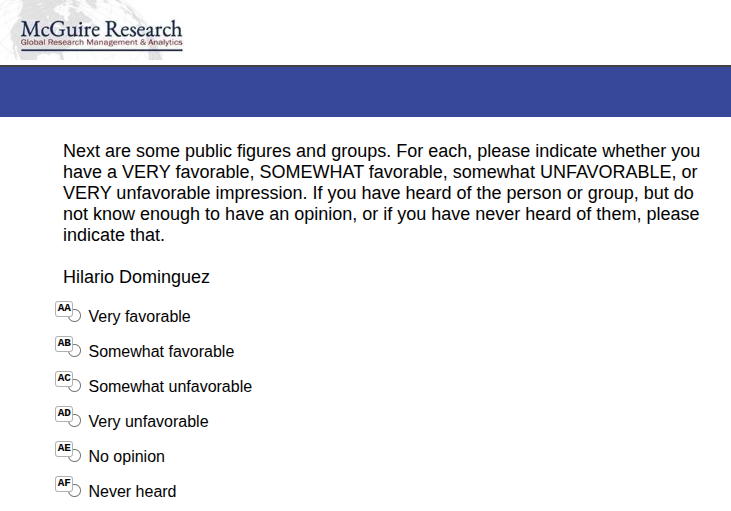
Lacking context and expecting a question about the mayor, my initial reaction was that I had never heard of Hilario Dominguez. Then it hit me…
Hilario Dominguez, isn’t he the guy who:
- Got into trouble with and was fined by the City of Chicago’s ethic board for not completing his ethics training?
- Was accused of discrimination and sexual harassment for repeatedly making a Nazi salute toward employees in calling them “Hitler” in front of students and then when asked to stop said, “What? You think any of these (expletive deleted) kids know history?”
- Had $35,000 in unpaid property taxes on the building listed as his residence?
- Is on video proclaiming his love for the slogan ‘defund the police’?
- Believes it’s a good idea to spend $2.9M each year to keep open a high school designed for 1,000 but with only 77 students enrolled & only 10% can read proficiently?
Yup, they’re asking about that Hilario Dominguez. The CTU stooge who is running for president of the Chicago Board of Education and endorsed by Brandon Johnson.
The next couple questions were identically worded, complete with the awkward capitalization, asking about favorable or unfavorable impressions of the Chicago Teachers Union and the “publicly funded privately run for profit charter school industry.” Wow, what a mouthful. Hold that thought; we’ll get back to it in a minute.
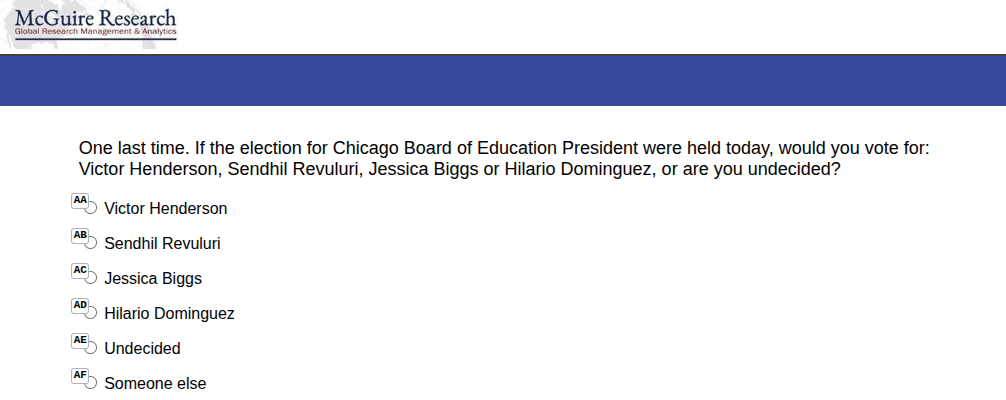
The next question, the last in this group, simply asked which candidate for school board president I supported. Oddly, before the survey concluded, I would be asked this same question three more times.
Just What Is a Push-Poll Anyway?
When trying to differentiate a push-poll from legitimate research, stay focused on the apparent purpose. Whereas a legitimate survey seeks to measure opinion, a push-poll attempts to change it. To put it another way, a push-poll is not about research but rather persuasion.
Consider:
A push-poll is “an interactive marketing technique, most commonly employed during political campaigning, in which a person or organization attempts to manipulate or alter prospective voters’ views under the guise of conducting in opinion poll.”
— Wikipedia
Or this from the American Association for Public Opinion Research:
A push-poll is “an insidious form of… campaigning disguised as a political poll. [The voters’ touchpoints] are not surveys at all, but rather unethical political telemarketing… disguised as research that aim[s] to persuade large numbers of voters and affect election outcomes, rather than measure opinions.”
Intelligent, thinking people can decide for themselves whether a phrase like “publicly funded privately run for profit charter school industry” is legitimate research or an unethical attempt to sway public opinion.
Back to the Survey
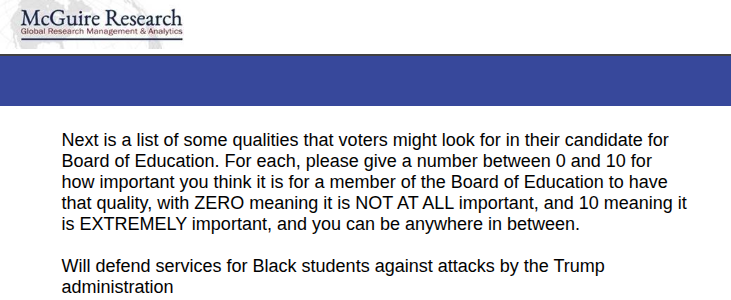
The questionnaire then launched into a long series of questions regarding qualities that voters might look for in candidates for the board of education. Respondents were asked to rank each provided statement on a scale from 0 to 10, with 0 meaning the statement is not at all important & 10 meaning it is extremely important.
Here are the statements to be evaluated:
- Will fight to tax millionaires and billionaires to fully fund public education.
- Not lay off any staff.
- Not close any schools.
- Kick ICE out of schools.
- Will defend services for Black students against attacks by the Trump administration.
- Supports universal full time pre-k starting at age 3.
- Supports sports and extracurriculars.
- Has a plan to get more young people jobs.
- Supports adding shop classes.
- Is endorsed by the teachers’ union.
- Supports fresher healthier meals.
- Will fight to reduce the cost of living.
- Supports closing schools to fix the budget hole.
- Has voted for layoffs & school budget cuts.
- Is funded by the publicly financed privately run for profit charter school industry.
- Is funded by billionaires.
- Supports sustainable community schools with wraparound services for parents and neighbors.
- Supports education in schools providing content culturally relevant to the people who live nearby.
- Supports restorative justice instead of punishing or expelling students.
- Letting the surrounding community create school policy.
- Supports closing underutilized schools.
Then it gives serves-up this loaded question:
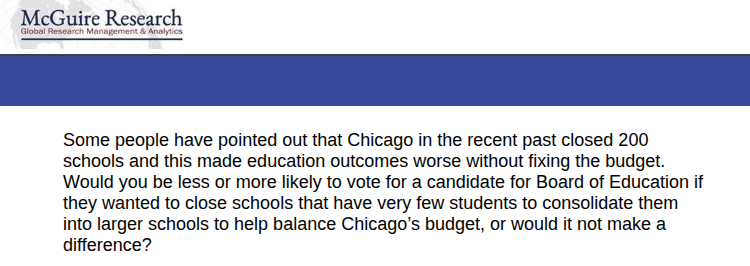
It then asks again – doubling-down – if the respondent still supports closing underutilized schools.
Take a moment and consider that list of issues or qualities presented. Not a single question regarding whether little Timmy or William can read at grade level. Zero consideration is given whether Maria or Michelle can perform basic math. No mention of graduation rates, ACT scores, and either work or college readiness.
It’s almost as if the CTU is focused on everything except education.
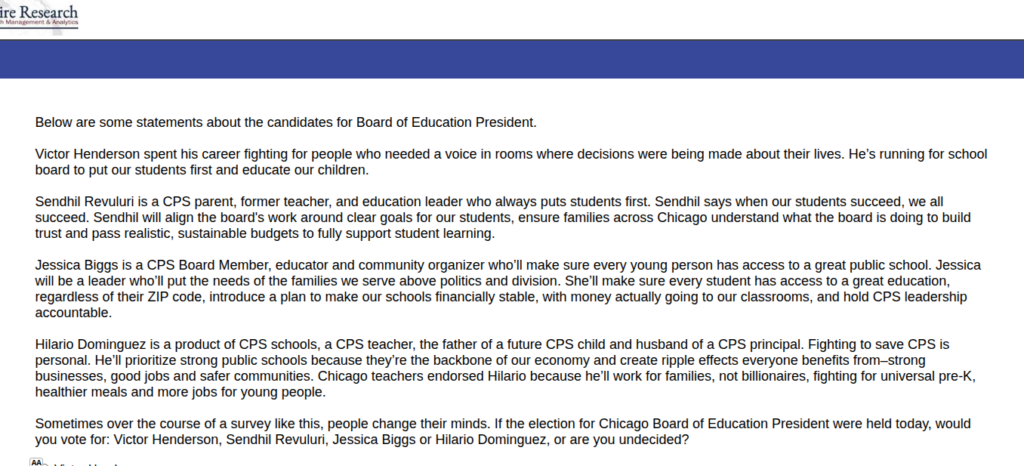
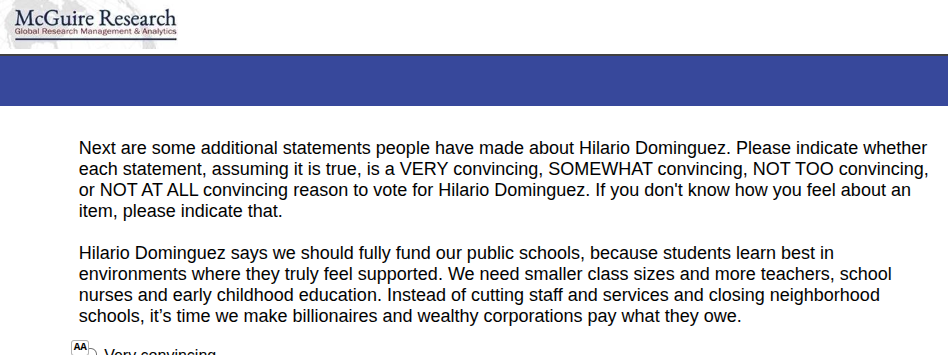
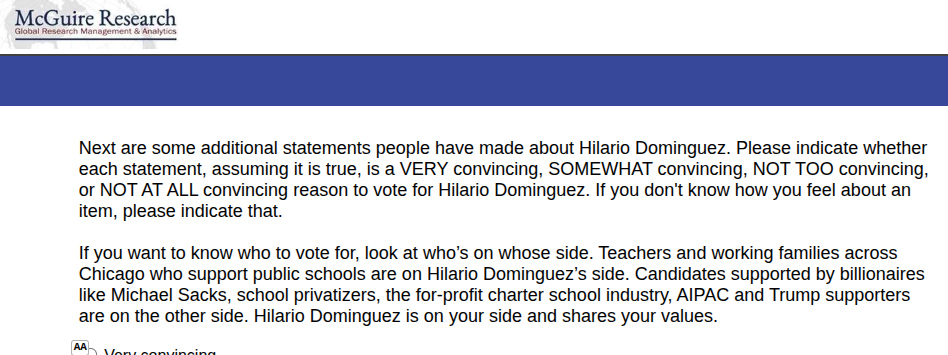
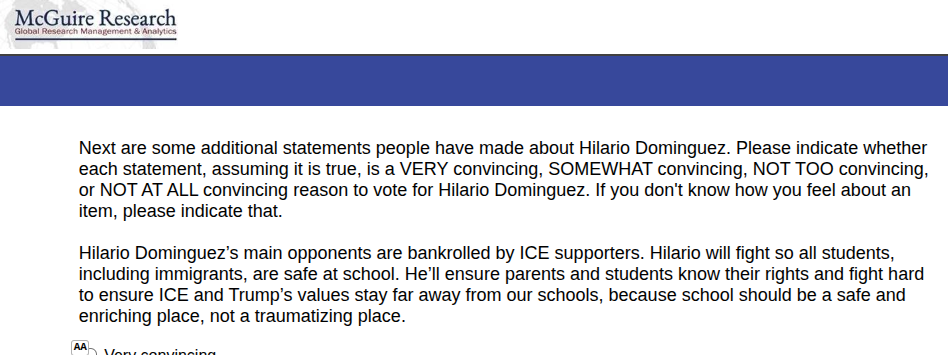
Up Next: All Hilario All the Time
After dealing with the non-issues, the rest of the survey focuses on Hilario, starting with this doozy:
and this…
and then this…
and this…
and this…
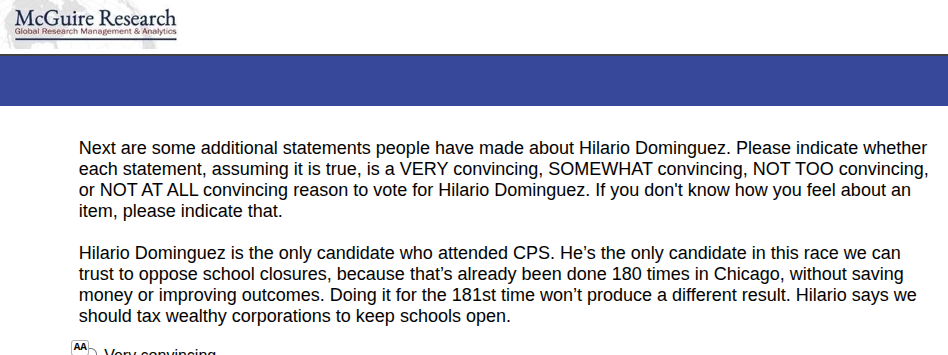
and this…
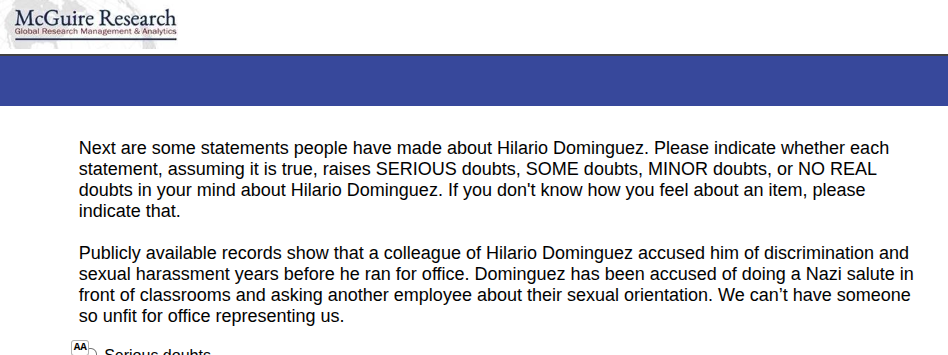
and this…
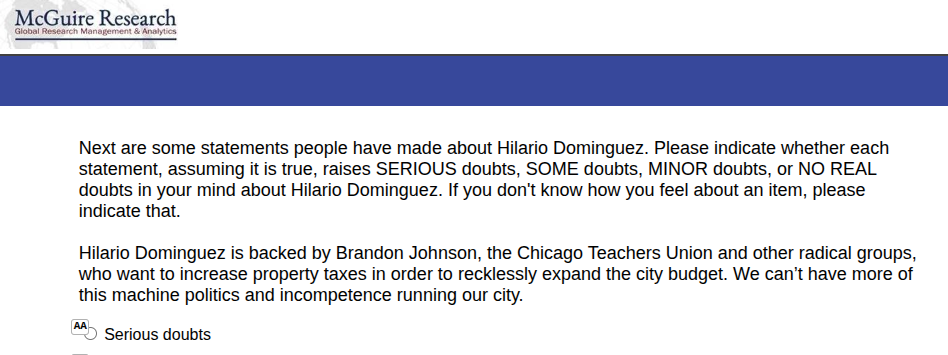
and finally…
Profound Incompetency
Unpacking all of this one can only come to the conclusion that CTU is horribly mismanaged and should probably be disbanded so a new organization can form from its ruins.
This survey came out on September 12th, roughly four weeks before the election. If CTU wanted the results to aid them with candidate selection then the survey should have been taken in spring or summer at the latest. Cefrtainly before signatures were gathered and the ballot objections have been heard. Now, CTU is now stuck with Dominguez whether they want him or not.
If CTU tells you this survey was about candidate selection you know they are lying, grossly incompetent, or both because the results cannot help them with candidate selection.
If the survey was meant to establish the campaign platform, again, that should have been done months ago. Dominguez is already on the record regarding all of the issues mentioned. The record is clear, the platform well defined, CTU wants to increase your taxes, make your life more expensive, and grow the nanny-state by gaining more control over yourself and your children without worrying about actual education.
If CTU tells you this survey is about campaign messaging you know they are lying, grossly incompetent, or both because the results cannot change the messaging that CTU and Dominguez have already been putting forward for months.
No,